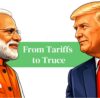
The recently announced India–US trade deal between Prime Minister Narendra Modi and U.S. President Donald Trump marks a significant turning point in bilateral trade relations. After months of tariff uncertainty and geopolitical pressure, the agreement has brought clarity to markets and businesses on both sides.
The immediate market response was strong. Indian equities rallied sharply, with the Sensex rising more than 2,500 points, reflecting relief rather than euphoria. To understand why markets reacted the way they did, it is important to look at how the trade tensions began, how they escalated, and what exactly has changed now.
How the India–US Trade Tensions Began
Trade friction between India and the U.S. intensified when Washington adopted a more aggressive reciprocal tariff framework, aimed at countries it believed maintained unfair trade barriers. India, despite being a strategic partner, was not exempt from this approach.
The situation worsened as the U.S. imposed progressively higher tariffs on Indian exports, affecting sectors such as engineering goods, textiles, auto components, and other export-oriented industries. These measures introduced uncertainty for Indian exporters and raised concerns about long-term access to the U.S. market.
The Role of Russian Oil in the Escalation
A key factor in the escalation was India’s increased imports of Russian crude oil. Amid global energy disruptions, India sourced oil at discounted prices to manage inflation and energy security. However, this drew geopolitical attention.
The U.S. linked part of its tariff stance to broader geopolitical concerns, effectively using trade measures as leverage. This resulted in additional tariff pressure, pushing duties on Indian goods to levels that markets viewed as unsustainable over the long term.
Why the Situation Became a Market Risk
By mid-2025, the India–US tariff dispute had become a systemic risk rather than a sector-specific issue:
- Exporters faced margin pressure
- Businesses struggled with pricing visibility
- Markets priced in prolonged uncertainty
- Global investors turned cautious on trade-sensitive sectors
Even companies not directly impacted by exports felt the ripple effects through currency volatility and risk sentiment.
What the New India–US Trade Deal Changes
- Tariffs on Indian goods have been reduced from elevated levels
- Penalty tariffs linked to Russian oil imports have been removed
- Both sides signaled intent to deepen trade and economic cooperation
- Energy sourcing and trade balance discussions have been brought back to the negotiation table.
Why Did Markets React So Strongly?
- Reduced policy risk
- Improved earnings visibility for exporters
- Lower geopolitical overhang
- Better alignment between two major economies
What This Means for Investors
For investors, the key takeaway from the India–US trade deal is not about chasing short-term market moves. Instead, it reinforces a familiar lesson:
Markets move sharply when uncertainty clears, often faster than fundamentals change.
Trade agreements, geopolitical clarity, and policy visibility can influence market sentiment just as much as earnings and growth data.
What Lies Ahead
While the trade deal is a positive development, it is not the end of the story. Global trade remains sensitive to geopolitical shifts, energy dynamics, and policy decisions. However, the agreement provides a stronger base for stability in India–US economic relations.
For businesses, exporters, and investors, the deal reduces immediate risks and restores confidence — a necessary condition for long-term planning.
Conclusion
The India–US trade deal marks an important reset after a period of heightened tariffs and uncertainty. Markets reacted positively because clarity returned, not because risks disappeared entirely.
As always, sustainable wealth creation dependsWhile the trade deal is a positive development, it is not the end of the story. Global trade remains sensitive to geopolitical shifts, energy dynamics, and policy decisions. However, the agreement provides a stronger base for stability in India–US economic relations.
For businesses, exporters, and investors, the deal reduces immediate risks and restores confidence — a necessary condition for long-term planning.
On discipline, diversification, and understanding how global events shape market behavior — beyond headlines.
If you would like clarity on how such developments fit into your broader financial planning,
you may write to us at celebratinglife@ascentsolutions.in