
For decades, India stored a large portion of its gold reserves in overseas vaults, mainly with the Bank of England and the Bank for International Settlements. This was common global practice and a legacy of older financial arrangements, international trade norms, and the need for safe storage abroad.
Over the last few years, something important has changed. The Reserve Bank of India has begun bringing this gold back home.
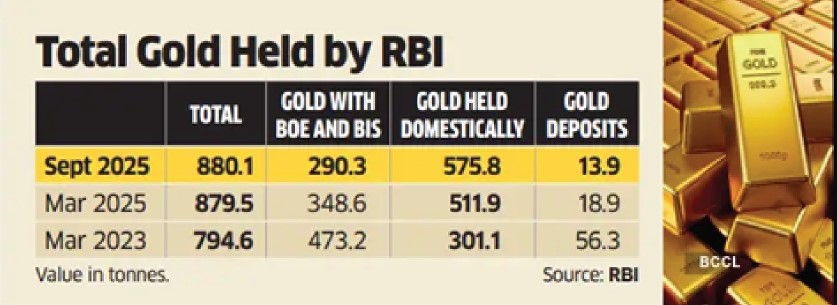
From March 2023 to September 2025, India repatriated almost 274 tonnes of gold. This includes more than 64 tonnes brought back in only six months of the financial year.
2025 to 2026. By September 2025, more than 575 tonnes of India’s gold was stored inside the country. This is more than 65 percent of the total reserve.
This is one of the largest movements of India’s gold since the 1990s. And it reflects a much deeper shift in how India thinks about control, sovereignty, and financial safety.
Quick thought before we move further:
What do you think triggered this shift — global risks or domestic confidence? Share your first instinct in the comments.
What Exactly Is RBI Doing
India’s official gold reserves reached 880 tonnes in September 2025. This is split into three parts:
- 575.8 tonnes stored within India
- 290.37 tonnes stored abroad with the Bank of England and BIS
- 13.99 tonnes under gold deposit arrangements
The proportion held within India has risen steadily as the central bank works toward keeping more of its physical assets under its own control.
1. Strengthening National Sovereignty
The world has entered a period where financial assets can be used as instruments of pressure. In 2022, after the Russia and Ukraine conflict began and Afghanistan saw a regime change, G7 nations froze the foreign reserves of both countries. Russia alone lost access to almost 300 billion dollars held abroad. This shocked governments around the world. It also raised a difficult question.
Are national reserves truly safe if they are held in foreign jurisdictions?
For India, bringing gold back home reduces this vulnerability and increases control over its most trusted asset.
Would central banks across the world eventually consider domestic custody as the default? What’s your view?
2. India Now Has the Infrastructure to Store It
Earlier, India depended on overseas vaults because domestic storage capacity was limited. This is no longer the case. RBI now maintains modern high security vaults that can store large volumes of gold safely. With this infrastructure in place, keeping gold abroad is no longer a necessity.
3. Lower Custodial Costs and Better Flexibility
Overseas storage includes custody fees, insurance charges, and transport expenses. Gold stored in India reduces these costs. More importantly, domestic storage gives the central bank quicker access to its gold during periods of financial stress. That access can be useful for liquidity support, swaps, or other monetary operations.
4. Shielding Against Geopolitical Risk
As global tensions increase, assets stored abroad can become difficult to access during sanctions, political disputes, or economic crises. Gold kept inside the country is protected from such risks. Control becomes the biggest form of security.
5. Strengthening Reserve Composition
Gold now makes up almost 14 percent of India’s total foreign exchange reserves, up from 11.7 percent only six months earlier. Gold acts as a hedge against inflation, a protection against currency volatility, and long term store of value. RBI is believed to be moving toward a gold share closer to 20 percent in future years.
A Global Shift: De Dollarization and the Return to Real
India is not alone in this strategy.
Countries such as China, Turkey, Russia, Poland and several emerging markets have increased gold purchases to record levels. In the first half of 2025, global central banks bought almost 415 tonnes of gold, compared to earlier years where the numbers were far lower.
This reflects a growing belief that the world is moving toward a more multipolar financial structure. Many nations want to reduce dependency on the US dollar and keep more assets under their own control. Gold is the only asset that cannot be devalued, frozen, or defaulted on by another country. This is why it has regained importance.
What This Means for India
- A stronger financial safety net
More gold stored domestically gives India better protection against global currency shocks or market stress. - Greater control over reserves
India reduces its reliance on Western financial institutions and foreign jurisdictions. - Strategic positioning for the future
Nations with stronger self controlled reserves will be better prepared for periods of global uncertainty.
The Bigger Picture
RBI’s gold repatriation is not a small operational decision. It is a strategic shift that reflects a changing world.
International laws are being challenged more frequently. Financial sanctions are being used more often. In such a world, India is choosing to
hold the asset that has survived wars, crises, and every currency system ever created.
Gold kept at home is gold that cannot be taken away. By increasing the share of domestically held gold, India is strengthening its financial sovereignty and preparing for a future where control over national assets may matter more than ever.
What’s Your Take?
India is clearly preparing for a new global financial landscape. Do you believe repatriating gold strengthens India’s long-term monetary position, or should more reserves still be diversified globally? Share your perspective in the comment section.