If you have been following the markets recently, you would have noticed a clear shift in sentiment. Prices have corrected, news flow has turned cautious, and conversations have moved from optimism to concern. This naturally raises a question in the mind of most investors: is this just a passing phase, or is there something more structural at play?
What's Happening in the Markets
The current correction has not come out of nowhere. Over the past few years, especially in mid and small cap segments, markets had seen a strong run up. Valuations expanded, liquidity was easily available, and overall sentiment remained positive for a prolonged period.
What we are seeing now is a phase of adjustment. Global liquidity conditions have tightened, foreign investors have been reducing exposure, and the segments that had moved up the most are seeing a sharper correction. Such phases are a natural part of market cycles.
The Role of Geopolitical Events
Alongside this, geopolitical developments have added another layer of uncertainty. Events such as wars or conflicts tend to have a broader impact on the economy. They influence commodity prices, affect supply chains, and create hesitation among participants.
When multiple factors come together, market reactions tend to be more pronounced.
Investor Behaviour During Such Phases
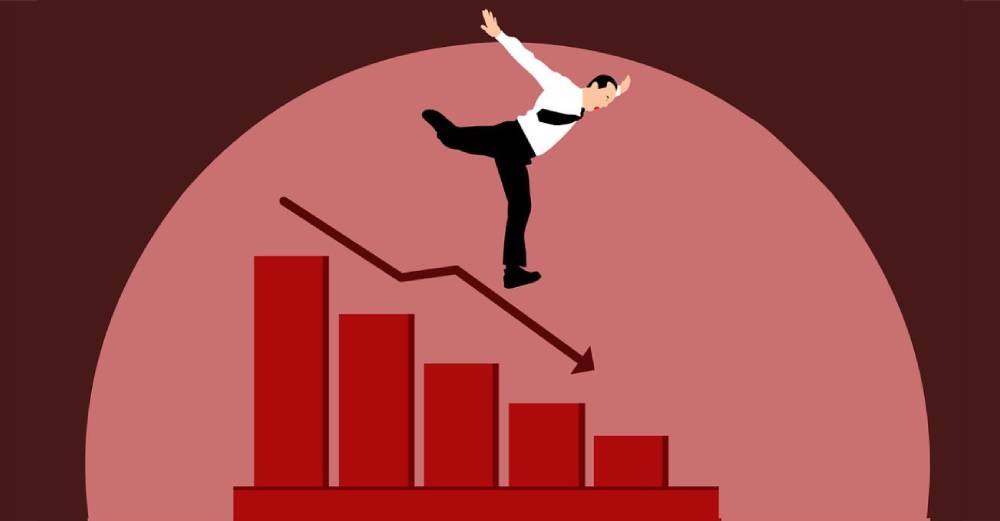
During periods like these, behaviour often follows a familiar pattern. Trading volumes increase on declining days, investors start reducing exposure, and sentiment weakens quickly.
This is not unusual. It reflects how investors respond when visibility reduces and outcomes become harder to predict.
How Institutional Investors Are Positioned
Institutional investors, on the other hand, tend to make measured adjustments rather than abrupt changes. Allocation gradually shifts towards cash or short duration instruments, exposure to cyclical sectors is reduced, and defensive sectors such as FMCG and pharma see relatively higher allocation.
This approach is more about managing risk and maintaining balance within the portfolio.
Understanding How Returns Are Generated
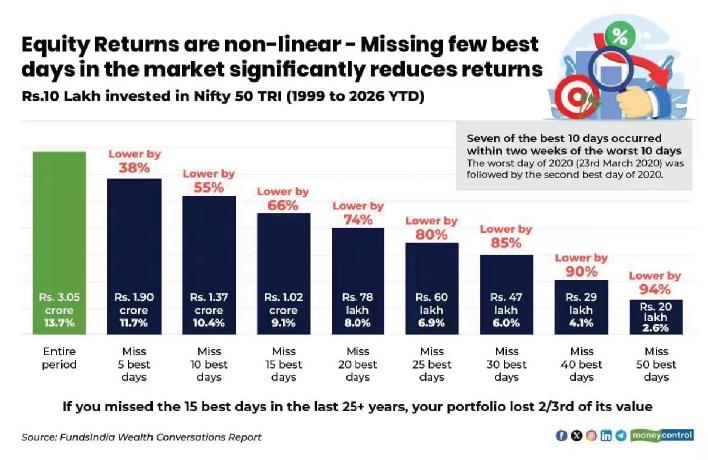
One aspect of equity investing that often goes unnoticed is how returns are actually generated over time. Returns are not evenly distributed. A meaningful portion of long-term performance comes from a relatively small number of days.
The impact of missing these days can be significant:
What History Indicates
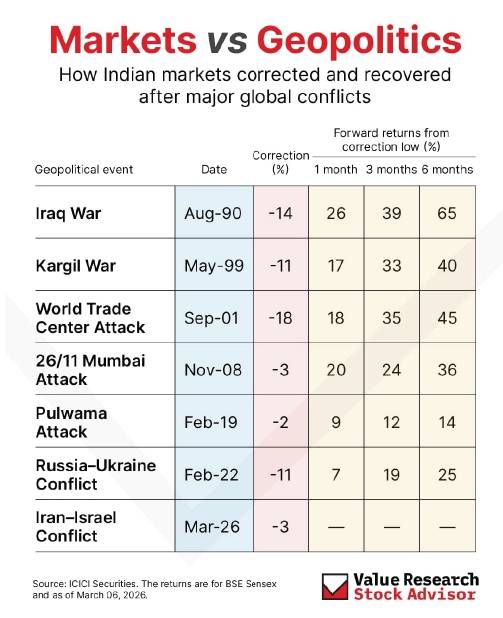
If one looks at past geopolitical events, a consistent pattern can be observed. Markets tend to correct during periods of uncertainty, but over time, they have also shown the ability to recover and move forward. For example, during the Iraq War, markets corrected by 14% but delivered 26% returns in just one month and 65% over six months. Again during the Kargil War, markets fell by 11%, but went on to deliver 17% in one month and 40% over six months. And the pattern continues.
What Should You Take From This
Phases like these are part of how markets function over longer periods. What tends to have a greater impact on outcomes is not the occurrence of such phases, but how one chooses to respond to them.
Decisions taken during such times often play a larger role in shaping long-term results than the market movement itself.
If you're unsure how to approach your investments in current market conditions, feel free to connect with us at +91 93270 34882 or write to celebratinglife@ascentsolutions.in