
5 min read
One of the most common mistakes investors make is assuming that a company which has performed exceptionally well in the past will continue to deliver superior returns indefinitely. This belief appears logical because successful businesses often inspire confidence. Investors become familiar with these companies, follow their performance closely and gradually develop a sense of comfort in holding them for years.
While there is nothing wrong with owning good businesses, there is an important distinction every investor should understand: a good company and a good investment are not always the same thing.
Table of Contents
Quick Summary
- A good company and a good investment are not the same thing — price paid, future growth and market expectations all shape returns.
- Over the last decade, none of seven well-known, highly respected stocks matched the Nifty 50 TRI's own return, even after including dividends.
- Portfolios often become concentrated by accident, not by design — winners are simply never sold.
- Diversification is not about sacrificing returns; it is about reducing dependence on any single company, sector or theme.
- Periodic portfolio reviews keep a portfolio aligned to present goals rather than anchored to past successes.
A Good Company Is Not Always a Good Investment
The quality of a business is only one part of the investment equation. The price at which you buy the business, its future earnings growth, market expectations and changing industry dynamics all influence the returns an investor ultimately earns.
A company that created tremendous wealth during one decade may deliver average returns during the next, even if it continues to remain an excellent business.
How Portfolios Become Concentrated Without Anyone Deciding To
Over the last two decades of advising investors, we have often seen portfolios become concentrated around a few familiar names.
This generally does not happen because investors deliberately want a concentrated portfolio. It happens because the companies they bought years ago performed well, and selling them gradually became emotionally difficult.
A Real Example: Two Portfolios, Ten Years Apart
Around 10 years ago, a husband and wife approached us for comprehensive financial planning. During the portfolio review, we noticed that the husband had accumulated shares of several well-known companies over many years. His portfolio included names like Infosys, TCS, Hero MotoCorp, Dabur, Lupin, Wipro and Sun Pharma. These were businesses that had earned the confidence of millions of investors over decades.
As part of our advisory process, we recommended gradually reducing the concentration in individual stocks and moving towards a diversified, goal-oriented investment portfolio. Our recommendation was not based on a negative view of these companies. It was based on a simple principle that no family’s financial future should depend excessively on the fortunes of a handful of businesses, irrespective of how successful they have been in the past.
The husband was hesitant to make any changes. From his perspective, these companies had rewarded him over the years, and there appeared to be no reason to disturb the portfolio. His wife, however, decided to follow the recommended allocation.
Nearly ten years later, the difference between the two portfolios became evident.
The diversified portfolio delivered significantly better outcomes — not because it discovered extraordinary investment opportunities or took higher risks, but because it was built around diversification, disciplined asset allocation and periodic portfolio reviews rather than attachment to individual companies.
What the Data Actually Shows
The illustration below highlights this principle with actual market data.
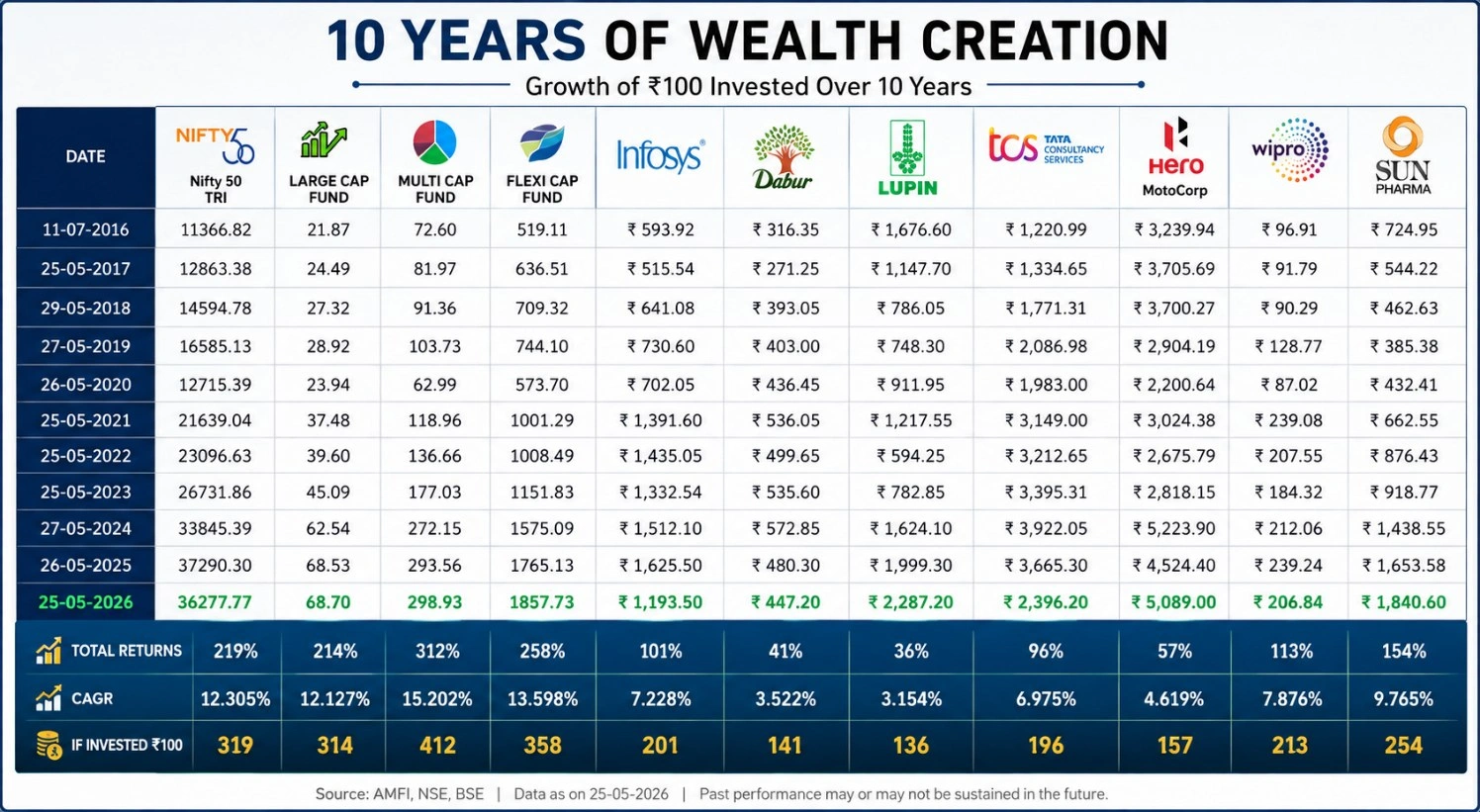
The most striking thing this data shows is this: even after including dividends, not one of these seven well-known, highly respected stocks was able to match the market’s own return over the last decade.
Meanwhile, a simple, diversified fund did.
So what’s actually happening here? Let’s break it down. These numbers include dividends, so they reflect the actual return an investor would have earned, not just the rise in share price.
₹100 invested ten years ago in the index and in diversified funds:
- Nifty 50 TRI — grew to approximately ₹319
- Large cap fund — ₹314
- Flexi cap fund — ₹358
- Multi cap fund — ₹412
The same ₹100 invested in the individual stocks:
- Sun Pharma — ₹254
- Wipro — ₹213
- Infosys — ₹201
- TCS — ₹196
- Hero MotoCorp — ₹157
- Dabur — ₹141
- Lupin — ₹136
Source: AMFI, NSE, BSE. Data as on 25-05-2026. Past performance may or may not be sustained in the future.
Why Excellent Businesses Don't Always Deliver Superior Returns
These numbers often surprise investors because each of these companies continues to enjoy a strong reputation and has built remarkable businesses over many years.
However, this comparison should not be interpreted as criticism of these companies. On the contrary, they remain well-managed organisations with strong competitive advantages. The data simply reminds us that excellent businesses do not automatically produce superior investment returns over every period.
Markets continuously reassess future growth expectations. As industries mature, competitive landscapes evolve and valuations change, yesterday’s leaders may deliver moderate returns while entirely different sectors or companies emerge as the next drivers of wealth creation. History shows that market leadership is rarely permanent.
Why Diversification Matters
Diversification is often misunderstood as sacrificing returns in exchange for safety. In reality, it is about reducing dependence on any single company, sector or investment theme. It acknowledges a simple fact: no investor can consistently predict which businesses will dominate the next decade.
Successful investing is therefore less about identifying one exceptional stock and more about constructing a portfolio that can withstand changing economic cycles while remaining aligned with long-term financial goals.
The Discipline of Periodic Review
Equally important is the discipline of periodic portfolio review. A portfolio that was appropriate ten years ago may no longer reflect an investor’s present financial goals, risk capacity or market conditions. Regular reviews ensure that portfolios evolve alongside changing circumstances rather than remaining anchored to past successes.
One of the most valuable lessons we have learnt while advising families over the years is that investors should avoid becoming emotionally attached to investments. Businesses evolve, industries change and markets continuously reward new leaders. Portfolios should evolve with them.
Conclusion
Yesterday's winners deserve appreciation for the wealth they may have created, but they should not be expected to remain tomorrow's winners simply because they performed well in the past.
The objective of investing is not to own the most admired companies. The objective is to build sustainable wealth that helps achieve life's financial goals with discipline, diversification and consistency.
Sometimes, that requires letting go of yesterday's favourites to make room for tomorrow's opportunities.