
Every morning, millions of Indians order breakfast on Zomato, pay their bills on Paytm, invest their savings on Groww, shop for beauty products on Nykaa, and pick up their prescription glasses from Lenskart. What most people don’t realise is that behind each of these everyday apps sits a wealth creation story — and the investors who backed them early are sitting on life-changing returns.
That’s the point: startup investing isn’t just about chasing gains. It’s about spotting transformational ideas before they’re mainstream, and structuring exposure in a way that aligns with long-term wealth objectives.
In this article, let’s explore why startup investing has become one of the most compelling routes to building long-term wealth.
India's Startup Ecosystem: The Official Numbers
The headline numbers tell the story quickly. India has crossed 2,00,000 DPIIT-recognised startups, making it the third-largest startup ecosystem globally behind only the US and China. The ecosystem boasts 117-125 unicorns, has generated over 17 lakh direct jobs, and attracted approximately USD 9.1 billion in tech startup funding in 2025 — up 23% year-on-year. Most telling for investors: 36+ companies with a combined estimated value of ~$100 billion are lined up for IPOs by 2027. The harvest is coming.
India Today vs. the US a Decade Ago: A Mirror Worth Studying
Think back to the US in 2014-15. Roughly 100 unicorns. Airbnb and Uber still private. The biggest venture returns still ahead. The investors who recognised that inflection point and stayed invested compounded extraordinary wealth over the decade that followed.
India today is at a strikingly similar moment — with one crucial difference. Its consumer base is four times larger than America’s was at a comparable stage, and UPI and smartphone adoption are still pushing into Tier 2 and Tier 3 cities. The parallels are imperfect, but the structural conditions — a massive digital consumer market, deep engineering talent, and a maturing VC ecosystem — are undeniably in place. The question is not whether India will produce its generation of defining companies. It already is. The question is whether you are positioned to benefit.
The asymmetry advantage: why startups can do what no other asset ever will
Every other asset class caps your upside. A startup can return 1,000x — and that single outcome can outperform a lifetime of conventional investing. Four structural reasons explain why.
- Loss is capped. Gain is not.
In equities, real estate, or gold, your maximum loss is 100%, and your upside is bounded by market growth — a great Nifty stock might 5x over a decade. In a startup, the downside is identical: you lose your cheque. But the upside has no ceiling. When Info Edge put 4.7 crore into Zomato in 2010, the worst case was losing 4.7 crore. The actual outcome was a stake worth over 39,455 crore at IPO — more than 1,000x (Business Standard, 2021). No listed stock, property, or gold bar has ever replicated that arithmetic. - Price Discovery Advantage
You buy before the world knows the price. When you buy a listed stock, millions of analysts and institutions have already priced in the opportunity. When you back a seed-stage startup, you are setting the price — before revenues, before brand recognition, before market consensus forms. That information asymmetry is the engine of extraordinary returns. Accel Partners entered Flipkart when Indian e-commerce was barely a concept; by the time Walmart paid $20 billion+ for a majority stake in 2018, the category had been won. They did not get rich by being smarter than the market. They got in before the market existed. - Network Effect
Network effects build walls no competitor can scale. Zomato is more valuable today because more restaurants list on it, which draws more users, which attracts more restaurants — a self-reinforcing loop that compounds value non-linearly. Groww is stickier because a larger investor base deepens liquidity and lowers costs for everyone. Once a startup achieves that kind of scale, displacement is structurally difficult. That dynamic is simply unavailable in commodities, fixed income, or physical assets, where one unit of supply is interchangeable with any other. - Power Law Math
The power law means one conviction bet funds the whole portfolio. Venture math is unlike any other asset class. Consider a portfolio of 10 startups at 10 lakh each. Seven return zero, two return 3x, one returns 30x. Total return: 3.6 crore on X1 crore invested — a 3.6x return with a 70% failure rate. In no other asset class does that arithmetic work. And if that one outlier returns 100% instead, the portfolio delivers 10.6x.
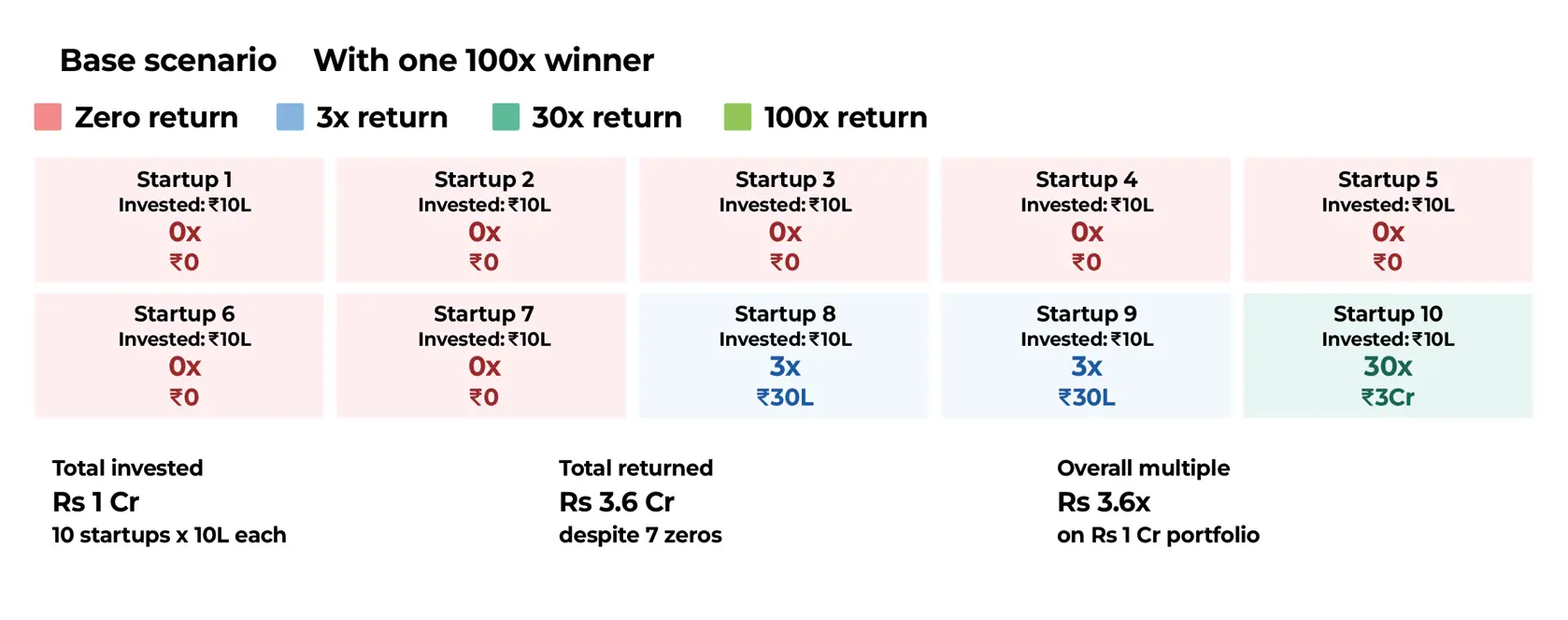
In every other asset, time and compounding do the work — slowly. In startups, value creation is non-linear. A company solving a real problem at scale does not grow at 12% a year. It can grow 10x in three years and 10x again after that. That is why a single early-stage conviction bet, held patiently, can do more for a family’s long-term wealth than decades of disciplined saving in conventional markets.
Startup Investing vs. Other Asset Classes
Understanding where startup investing fits into a broader portfolio is essential before committing capital.

Appropriate allocation for HNIs (as a % of investable financial assets, excluding primary residence and operating business assets):
- Conservative: 3-5% in SEBI-registered AIF/VC funds only
- Moderate: 7-12% across a combination of VC funds, co-investments, and syndicates
- Aggressive: 15-20% for sophisticated investors with long horizons, strong deal flow access, and adequate liquidity buffers elsewhere.
The cardinal rule: never allocate capital you may need within seven to ten years. Startup investing is a long-duration asset class, and liquidity events rarely arrive on schedule.

Risks, Tax, and Estate Considerations
Startup investing in India carries specific legal and financial considerations that deserve careful attention before committing capital.
Illiquidity is the primary structural risk. There is no guaranteed exit timeline, and secondary markets for unlisted shares, while growing, remain shallow compared to developed markets. A classic example is Byju’s, which was once valued at $22 billion: governance failures, unsustainable acquisitions, and financial opacity erased investor capital.
Dilution is inevitable across successive funding rounds. Insist on negotiating pro-rata rights and anti-dilution provisions in your shareholder agreement from the first investment.
On capital gains tax, gains from listed shares held over 12 months are currently taxed at 12.5% above 1.25 lakh annually. Unlisted shares require a 24-month holding period for long-term capital gains treatment, taxed at 12.5% with indexation benefit.
Conclusion
The Window Is Open — For Now
The investors who built meaningful wealth from Zomato, Nykaa, Groww, and PolicyBazaar were not merely lucky. They were early, disciplined, patient, and willing to ride through volatility to let the compounding work.
The companies that will define India's next decade of consumption, fintech, deep tech, and Al are being founded and funded right now. The question is whether you will be an observer or an owner.
NASSCOM Tech Startup Report, Business Standard, DPIIT